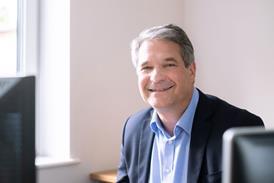

Premium Content: David Shepherd, Audatex’s regional managing director for the UK and South Africa, talks about his new role and the challenges ahead
Tell us about your new role and what it means for your customers?
It is a privilege to step into the role as RMD at Audatex UK and South Africa. I have a long-standing history with the company, having first been a customer when I set up and ran my own repair centres in 1989. I joined the Solera group, Audatex’s parent company, in 2008. Audatex UK has always been regarded as a leading player within the industry, helping to drive forward the global digital agenda across the insurance and repairer market and it’s an honour to be asked to take the reins at a time when that agenda is on every CEO’s to do list.
The world is becoming smaller as it adapts to digitalisation, and because of this technology shift, the industry is facing some challenges, alongside significant opportunities. As Audatex plays its part in that, my vision for the company is to deepen customer engagement, reinvigorate our core products and develop new solutions that will enable us to walk that digital journey together with our customers and their customers.
What are the top issues affecting your customers in claims right now?
Car technology evolution is proving to be both an opportunity and an issue. As vehicles become smarter, accidents are reducing in numbers – which is great for the safety of drivers. However, from an insurer point of view, fewer accidents means less claims, and in turn, an ever-reducing amount of contact with end customers. So, how do insurers maintain a relationship with customers in an era where people of all ages increasingly want to be treated as individuals? A solution for insurers could be investing in more active and engaging communication via a multi-channel approach, but as we know from research conducted by Solera, there is no one-size-fits-all communication channel for consumers.
Further, the rapid evolution of this smart technology generates another industry issue, one that relates to liability. In the event of an accident with an autonomous or semi-autonomous vehicle, is the liability with the driver or the vehicle manufacturer? it is feasible this technology could eventually shift driver liability to a product reliability issue, which means these vehicles will need to be maintained to the highest standards.
For repairers, lower claims volumes can also be an opportunity to engage more closely with their customers, the owners and drivers, and seek solutions for the non-insurance claims. We are already seeing this segment starting to develop with stand-alone repair booths and cabins.
How can Audatex help?
Over the years, Audatex has established itself at the heart of the claims industry, connecting all of the relevant parties that participate in a claim. Historically, our focus has been strictly B2B. Moving forwards, as we help our clients become digital and provide services to the end customers, we are also developing B2B2C enablement.
Solera has been investing heavily in vehicle maintenance and repair solutions as well as customer retention tools. The group has invested close to $1 billion in the UK alone acquiring companies such as AutoData and CarWeb (service maintenance and repair) CAP (vehicle valuation business) and HPI (vehicle provenance business).
When blended together, all of these assets provide a full life experience to vehicle owners, who can enjoy any of them separately or together, free to jump in and out at any point of their journey. With this uniquely connected ecosystem, we have the ambition to become a one-stop-shop to better serve our customers and their own end users.
On a larger scale, we also have the ability to leverage the Solera parent. The group carries out seven transactions every second, and 250 million transactions a year across nearly 90 countries, and enables Audatex UK and SA to access global knowledge and apply that locally.
What has been the biggest challenge for you personally in your insurance career?
When I joined Solera, I started working with teams across many countries, whereas previously, I had only worked in the UK. I soon realised that each country has its own way of doing business. Adapting to these sensitivities, recognising that every market operates with some uniqueness, was one of the biggest challenges I’ve faced.
A positive take-home from those experiences is that working on global accounts also provides an opportunity to pick and choose the more effective techniques from each nation. There is always a piece of best practice in each country that you can take and apply to other markets, sometimes verbatim, lift and shift, sometimes conceptually. Whether it’s technology or simply a best-practice process model, innovation is always a good thing to export.
What is your proudest achievement in your career in insurance?
When I took on a role covering Central-Eastern Europe at Solera as Regional Managing Director, we were in the midst of the worst recession most people had ever experienced. During a four-year period, I was able to work in conjunction with our local businesses and our customers to introduce our software and service solutions into these local markets. It enabled them to become more effective and improve productivity, in turn increasing profitability for them, and revenue for us. During this time, I also led our Global Account Management organisation and I like to think that I have left behind a team that is highly competent and capable to lead our customers on their digital journeys.
Finally, if you could be stuck in a lift with somebody for ten minutes, who would it be and why?
I would choose Jack Welch, former CEO of American company General Electric (GE). I admire the way he made that company what it is today, purely thanks to the way he dealt with and developed his people. Despite managing such a tremendous and diverse organisation, he managed to ingrain his principles and values throughout the whole conglomerate and move everything forward with his philosophy. And I find that fascinating. Today he has founded his own university and developed training programmes that we can all learn from.


No comments yet