

























Chief executive shares how she is leading the ‘small, scrappy trade association’ to transform its ‘unfocused’ approach to mitigating London-centric talent challenges into a targeted tool set that ‘concentrates on one problem statement’
When Caroline Wagstaff became chief executive at “small, scrappy trade association” the London Market Group (LMG) nearly five years ago, one of her first leadership initiatives involved reviewing what she feels was an ineffective “smorgasbord” of talent related projects.
Considering varying themes such as early careers, longer working lives, skills gaps and diversity and inclusion (D&I), the myriad schemes had been introduced over an 11-year period after the LMG ringfenced future talent as one of three core audience groups it wanted to engage with. The other two, for reference, are government and customers.

However, despite the LMG being a unique umbrella association that liaises with and supports the International Underwriting Association (IUA), Lloyd’s of London, the Lloyd’s Market Association (LMA) and the London and International Insurance Brokers’ Association (Liiba), the group itself only has a headcount of four employees – of which Wagstaff is one.
So, when she took the helm at LMG, Wagstaff advocated that any programmes of work the trade association wanted to implement had to be fiercely intentional and targeted if they were to be delivered well and reap meaningful results.
“We need to concentrate on one problem statement,” she tells Insurance Times in an exclusive interview ahead of the publication’s inaugural talent focused conference, Destination Insurance (15 January 2026).
“Our problem statement [is] why is it that young people do not see specialty insurance as a destination career in the same way that they would see management consultants, investment banking or asset management as a destination career? All the data tells us we’re just as important economically. We’re 2% of the UK’s gross domestic product (GDP).
“[The London market] employs 60,000 people. There are 350 firms. It should be the sort of place that young people are going ‘I really want to get into specialty insurance’ – but we know that they don’t.”
For Wagstaff, the primary driver for selecting this particular “problem statement” is because “everybody has an early years problem” – regardless of whether an organisation is a broker or underwriter, big or small.
She continues: “A rising tide will carry all ships. If more people hear about this as an industry, then you’ll get some better applicants and if you’re a great employer, then you’ll make out like gangbusters. Everybody gets something out of it. It is the common problem we all share.
“The [LMG previously] flitted around between all sorts of things and people didn’t really know what it was trying to do – and that made it hard to get people to be supportive. You might call me a one trick pony, but everybody knows [now] what our trick is. Our trick is early years talent and that’s what we’re doing.”
The nuts and bolts of a ‘multitouch point journey’
The key barrier to attracting and engaging diverse young talent, according to Wagstaff, comes down to poor storytelling and utilising unpopular communication channels.
Read: Briefing – Making insurance careers a choice rather than ‘falling’ into the profession
Read: Briefing – Attracting talent in the UK insurance industry – Progress, challenges and opportunities
Explore more talent related content here, or discover more briefing articles here
She explains: “For about 350 years, we’ve done a pretty terrible job at telling young people that there’s this incredible career opportunity.
“People go into what they see, which is why you see quite a lot of families working in the market. But that means we have to make it visible to those who don’t see it. I want [the London market] to look a bit less white and male.
“So, telling a better story, telling it in the channels that young people actually hang out in, rather than where we think they hang out. Lots of use of social media and not going to careers fairs. Kids don’t go to careers fairs anymore. [This is] what I call productive outreach.”
As a result of this viewpoint, Wagstaff has created what she describes as a year-long “multitouch point journey” of in-person talent linked initiatives that seek to showcase what an insurance career can look like, targeting both school and university students. This kicked off in 2023.
The succession of in-person talent programmes starts with the LMG conducting presentations on specialty insurance at around 50 London-based schools between January and May, which Wagstaff notes are “all in areas of high socioeconomic challenge” – with the institutions receiving the high pupil premium additional government funding due to having a large volume of disadvantaged pupils and the students themselves being eligible for free school meals.

At the end of these sessions, students are able to scan a quick response (QR) code to register their interest in the LMG’s two-week Futures Academy, which held annually in July.
This programme enables two 75 student cohorts to complete a week of team activities – including Dragon’s Den style sessions, mentoring opportunities and presenting to the LMG board – followed by four days of work experience at a market firm and attending a celebratory careers festival to conclude the experience. Around 50 firms offer work experience placements for the Futures Academy, including Aon and Liberty Specialty Markets, to name a few.
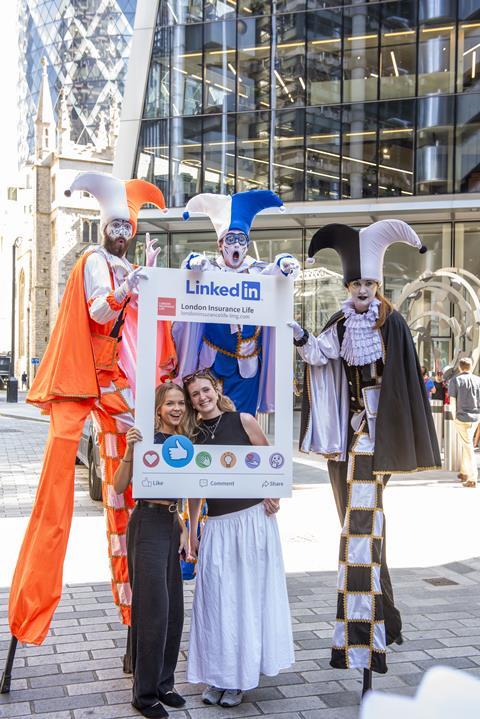
In 2025, the careers festival was held in Lime Street, outside the Lloyd’s of London building. Around 400 attendees enjoyed pizza, ice cream, live music from a DJ and circus acts such as stilt walkers.
“We had a professional photographer so that the kids could get proper headshots taken, we had a curriculum vitae (CV) surgery, did some fireside chats. It was a full on morning up until two o’clock,” Wagstaff adds.
This method of communication and engagement appears to be driving results. Wagstaff explains that in 2024, the LMG delivered presentations to 1,500 students. This led to 850 pupils registering for the Futures Academy via the QR code. A two-stage filtering process saw the LMG cut the number of applicants down to 450 and then again to the final “150 sparkliest”, with “a quota per school” to ensure fairness.
The next part of the LMG’s footprint of in-person talent initiatives is called Apprenticeship Discovery – a three-day programme held in the October half term that is targeted at the 150 Futures Academy participants that are “interested in an entry level school leaver role”. Around 75 students take part in Apprenticeship Discovery, which Wagstaff describes as “a mock assessment centre” where pupils undertake mock job interviews, meet market firms and apply for jobs.
Wagstaff continues: “We’re really trying to upskill them because they all come from areas where no one gives them this training.
“We’re very used to middle class white kids who are all coached within an inch of their lives. These kids, 35% of them are [from] low income families, 65% [are] ethnic minorities. And they’re great. Some of them are such stars. You can just see it. It’s everything I wanted it to be.”
Wagstaff is pleased with the take up of these initiatives so far. In 2023, its first operational year, 100 students did the Futures Academy and 35 did Apprenticeship Discovery, with 15 of that overall cohort now working in the London market.
In 2024, 150 students completed the Futures Academy, with 75 going on to do Apprenticeship Discovery. Of this cohort, 25 are currently working in the London market.
Wagstaff says: “I’m really confident that we’re helping [the] market find diverse talent, which is hard for small to medium-sized businesses.”
Expanding the online footprint and support
Underpinning this in-person programme of talent activity, Wagstaff instigated a spruce up of the LMG’s talent linked website, London Insurance Life, as one of her first steps upon becoming the trade association’s chief executive because it is vital to have “somewhere to send people”.
Read: Broker CEO Forum – Industry must make talent development ‘strategic and intentional’
Read: Ela Metalia – Inside the IUA’s bid to bridging generations and next gen engagement
Explore more talent related content here, or discover more news analysis here
The website’s content now includes videos, podcasts, visible role models and what Wagstaff calls the “passion page” – this explains the insurance requirements and needs behind popular hobbies and interests, to showcase the intersection between insurance and everyday life that many young people are unaware of.
“I was talking to a young terrorism underwriter and she said her friends think she sells insurance to terrorists. We do have this weird language that we use,” Wagstaff observes.
London Insurance Life launched a new section for apprentices in 2025, as well as added downloadable document packs for market firms to take into school presentations from September last year.
The site additionally features a “really impactful, populated jobs board”, with up to 60 firms currently advertising roles. The jobs board also includes an archive of past jobs, enabling young people to research the types of roles and salaries available in the London market.
Alongside London Insurance Life, Wagstaff says the LMG posts on LinkedIn, Facebook and Instagram every day, either sharing job advertisements, fun facts about insurance – such as actor Tom Holland getting injured while filming Spider-Man: Far From Home – or using content from graduate or market influencers.
“That is a beast you need to keep on feeding,” Wagstaff acknowledges.
In September 2024, the LMG also launched its Talent Hub – Wagstaff defines this as a bit like “university clearing”, where the trade association runs an assessment centre and then provides SMEs looking for young talent with a shortlist of suitable candidates.
Although this initiative was not as successful as Wagstaff envisioned in 2024, she kickstarted the Talent Hub again in 2025 with a revitalised timeline, conducting the assessment centre work in December 2025 ahead of matching potential candidates and jobs in January 2026.
Another digital initiative that Wagstaff initiated in the last year was a collaboration with the LMA and IUA in association with online work experience platform Forage – students are able to complete online work experience for credits that they can feature on their CVs.
The trade bodies collaborated on producing a claims module for Forage, which 1,000 students have completed to date. For 2026, Wagstaff is keen to create a risk-based module that covers both broking and underwriting.
A further focus for 2026, according to Wagstaff, is finessing the LMG’s Pathfinder Programme.
Launched in 2025, this follows a similar vein to the Talent Hub, but is instead focused on “entry level roles [across the] wider set of middle office support services”, such as human resources, legal or information technology.
LMG provides Pathfinder Programme participants with six training sessions designed to upskill them, introduces them to employers and then helps them secure a role on a 12-month fixed term contract.
With eight employers currently signed up to this initiative, Wagstaff says that 16 roles have been filled so far in the November 2025 to June 2026 window allocated for this year’s programme. She aims to fill 20 roles by the end of this period.
‘Consistency of effort’
As an advocate for the London market, Wagstaff is witty, personable and a driving force to be reckoned with if the results of the LMG’s talent projects to date are anything to go by.
“I’m very bored of us all admiring the problem, beating our chests and saying ‘oh, nobody loves us. Let’s go and eat worms, nobody wants to work with insurance’,” she says.
“Actually, [looking at the 2025 careers festival, I thought] here is a market that is genuinely proud of being a great place to work. [There is] firm support, young people who love their jobs. The market really got its head up and said ‘look at us. We rock. Cool kids’.”
Despite the impact Wagstaff has undoubtedly made during her tenure at the LMG so far, she is incredibly cognisant of the ‘rinse and repeat’ mentality that has to happen in the early career field if any momentum is to be maintained – something she throws out as a market-wide call to action.
She explains: “I keep saying to people you do realise it’s not like building a soap brand? These are not customers for life. Next year, there’s a whole load of new 17-year-olds who’ve never heard of insurance. You’re on an escalator. You have to keep going up it.
“I know what this market is like. [It is always asking] shouldn’t we be doing something new and shiny? The answer is no. We have to keep doing the same old, same old because it does work and you just need that consistency of effort.”

Since joining Insurance Times, Katie has successfully obtained a number of industry accolades. At trade body Biba's 2025 Journalist and Media Awards, for example, Katie was named the overall winner and received the Journalist of the Year trophy, alongside the Best Thought Leadership Award for her briefing article on reproductive health MGA Juniper and how insurance can be used to positively impact taboo subjects.View full Profile





























No comments yet