
























Broker digital leader additionally emphasises that the current administrative cost ratio in the Lloyd’s market poses an ‘existential threat’, blaming ‘analogue’ trading methods
Digitalisation work in the UK company market is outpacing and achieving what Lloyd’s of London aspires to complete with its much-delayed digital transformation project Blueprint Two, with like-minded market firms better embracing electronic data exchange to reduce both process friction and operational cost.
This consensus was reached during a briefing session called Connecting Markets, hosted by electronic standards and workflow business Acord on 3 February 2026 in London.
The dinner time event brought together what Chris Newman – president and chief executive of Acord’s technology focused arm, Acord Solutions Group (ASG) – described as “the coalition of the willing”, referencing company leaders, firms and trade associations that want to drive digitalisation.
Addressing industry participants and trade press in attendance, Newman said: “Connecting [insurance] markets is all about digital connectivity and, right now, it very much feels like a perfect storm across digitalisation, across our industry, more than any time that I can remember.
“It really does feel that it’s the right time for digitalisation [in the global reinsurance and specialty markets because we have a] very educated marketplace with a desire to digitalise.
“I find it very interesting that people actually care about data. It’s taken a very long time. Ultimately, that’s what insurance is about – data. It seems there’s been a mindset shift over not that long a period.
“Clearly, we have lots of different technology enablers in the market – be that via application programming interface (API) connectivity or artificial intelligence (AI). We’re seeing stakeholders across various markets globally, with different levels of digital maturity, all trying to do their own [digitalisation] journey, but they’re all coming together as well, at the same time.
“The time now feels better than ever and we’re starting to see it in action.”
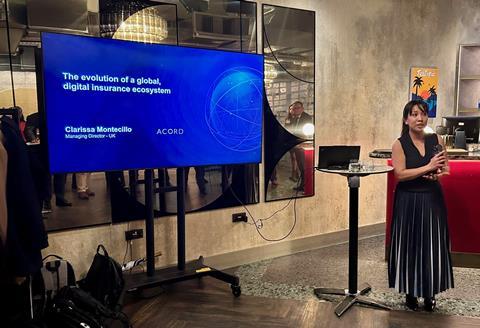
Clarissa Montecillo, UK managing director at Acord, added: “Every firm in the market is looking at modernising or transforming their internal processes. Everybody is flirting with AI, digital platforms are being replaced, they’re looking at analytics. All of this sits on top of data.
“Most firms are doing [this work] within the boundaries of their own estates, which means that the benefits exist within their boundaries. What the coalition of the willing is looking to do is to try and extend those benefits outside of [these] boundaries.”
‘Very worrying’ costs
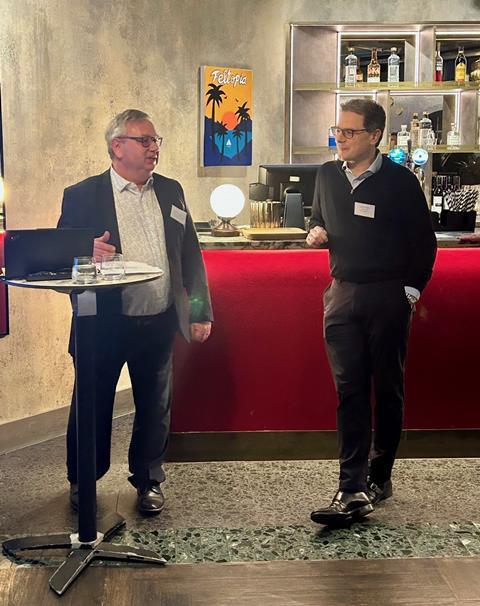
Anthony Siggers, digital leader at Marsh Specialty UK, laid out a compelling case for digitalisation, directly linking “analogue” trading methods with increased operational costs – he described this correlation as “an existential threat” to market firms.
Read: In Focus – How insurers use data to support broker schemes – and what happens when it’s limited?
Read: Briefing – The Leadenhall Project – Do not let anyone say ‘AI told you so’
Not subscribed? Become a subscriber and access our premium content
Explore more TechTalk related content here, or discover more news analysis here
He cited figures from the Lloyd’s Annual Report 2024, published in March 2025, which indicate that Blueprint Two digitalisation delays are having financial ramifications – in his view, contributing to why the company market is taking modernisation matters into its own hands.
He referenced Lloyd’s 34.4% expense ratio within this report, calling out that the administrative expense ratio contributing to this figure is 11.8% – an increase on the 7% reported 20 years ago, he said.
Siggers continued: “Despite billions of dollars of investment in technology, huge amounts of effort [and] four cycles of market modernisation, we’ve gone from 7% to 12%. That’s very worrying. That’s an existential threat. [Lloyd’s] has [a] cost problem and that cost problem is getting worse.”
His “thesis” on this worsening percentage “is that we still fundamentally trade in analogue way, trade through the exchange of documents”.
He continued: “If we send a submission to the market, it would be an email of documents. [You would then need to] take those documents, pull the data out and key it into a bunch of systems. The only way we fix this is by getting rid of the documents [at the start].”
For Siggers, although Blueprint Two is “incredibly important and will happen at some point”, it is vital that market firms do not “let whatever’s happening with Blueprint Two paralyse the marketplace”.
With this in mind, Siggers has been busy at Marsh Specialty UK. For example, the organisation is preparing to launch a new broker workbench in H2 this year that provides “a digital trade environment”, working as a “sat nav” to clearly connect brokers with marketplaces’ cover appetite.
He explained: “There’s still a lot of trading activity that is still done [via] email and we have to tackle that – that’s the Holy Grail. To get there, we have to move our brokers into a digital trade environment.
“It’s about creating [a] trading stream that brokers will want to live in, where they can see everything going on through a single pane of glass, which services all the capabilities they need to be better brokers, everything on one page. That’s [why] we’re building the workbench.
“What [we have done] is connect lots of different systems under [the workbench]. The brokers won’t know that. It’s just going to be a single test. That will start to replace emails and spreadsheets. If it’s cheaper to trade with us, then the markets will give us better pricing.”
Siggers called the broker workbench “completely game-changing” because it enables information to go “out as a digital submission, which means the markets can consume the data directly into their system”.
The broker workbench functionality will also include being able to track follow appetite via an API.
The recent development of the broker workbench builds on digitalisation work Marsh Specialty UK did two years ago, when it moved around 90% of its “business onto a digital training platform called Whitespace”.
Montecillo agreed with Siggers about the cost implication of non-digital operations.
She added that it is “more expensive to operate within London because of the way the bureau operates” – referring to Lloyd’s central back office. She noted that Acord’s electronic back office transactions (Ebot) and electronic claims office transactions (Ecot) functionality would “automatically reduce operational costs”.
Data drumbeat
The common thread across all of the evening’s speakers – which also included Dave Matcham, global ambassador for digital markets at Acord Solutions Group, and Simon Squires, head of market transformation for UK and Lloyd’s at Axa XL, which conducts digital data exchange with Marsh – was the importance of “complete and accurate data” underpinning AI and operational processes.
Squires, for example, described “getting structured data right at the beginning of the submission process” as “the golden egg”.
Siggers continued: “Our market relies on complete and accurate data. We price and insure multimillion, sometimes multibillion dollar risks. We’re not going to rely [solely] on AI. Regular data [is needed] to support those decisions. The foundation of everything we do has to be complete and accurate data.
“AI sits on the layer above data. But if you’ve got complete and accurate data, then you can apply AI to automate activities. We’re not going to just rely on AI. We’ve got to get foundations right.”
Newman confirmed: “Mature data standards [have] been here for a number of years.”

Since joining Insurance Times, Katie has successfully obtained a number of industry accolades. At trade body Biba's 2025 Journalist and Media Awards, for example, Katie was named the overall winner and received the Journalist of the Year trophy, alongside the Best Thought Leadership Award for her briefing article on reproductive health MGA Juniper and how insurance can be used to positively impact taboo subjects.View full Profile































No comments yet