





















’We predict 2026, there will be some sort of physical protest against data centres and what they represent in terms of unwanted energy demand,’ says chief executive
Beazley has warned that surging energy use from artificial intelligence, social tensions over job displacement and rising geopolitical volatility will create a far more combustible risk environment for businesses in 2026.
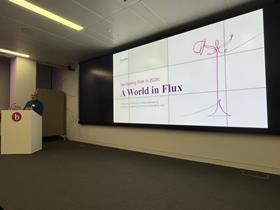
Speaking at the carrier’s Risk & Resilience Predictions 2026 briefing, chief executive Adrian Cox and chief financial officer Barbara Plucnar Jensen told the audience that overlapping risks are now amplifying one another.
“We’re operating in a world where the pace and complexity of risk have never been greater, and the boundaries between risks are beginning to blur ever more,” Cox said.
“Everything everywhere, all at once, everything’s matching up at the same time.”
Cyber risk and energy hungry AI
Beazley said one of the defining risks for 2026 will be public backlash against the physical footprint and energy consumption of AI infrastructure – particularly data centres.
Read: Lloyd’s market’s ‘first’ nuclear fusion insurance facility launches
Read: Insurers urged to back nuclear fusion as commercial viability nears
Explore more risk management-related articles here, or discover other news stories here
The firm predicts this pressure will tip into open confrontation next year. “We predict 2026 there will be some sort of physical protest against data centres and what they represent in terms of unwanted energy demand and what they’re doing, which is fundamentally taking people’s jobs,” Cox said.
“Both governments and businesses need to prepare for protests that are not only more frequent, [but] more disruptive.”
Meanwhile, cyber risk remains one of the most volatile threat categories for 2026, with incidents now at “record-breaking” levels and attacks “growing in scale, sophistication and cost”.
“When we asked in January this year, 29% of global executives still expect cyber to be their biggest tech risk,” Cox said, noting that the threat is now embedded deep within third-party and supply chain networks.
The fallout from the Jaguar Land Rover attack, which hit 0.2% of UK GDP in September, stresses this systemic exposure.
“It wasn’t an incident that impacted just one company. It had an impact across a whole variety of its supply chain,” Cox said.
“The scale and interconnectedness of today’s digital infrastructure means that the fallout is no longer just IT teams – it hits revenue, reputation, resilience and your customers and your suppliers.”
With threat actors encouraged by “noisy success”, Beazley warned that clustering and copycat attacks were increasingly likely. “Success attracts flatterers, imitators,” Cox added.
The carrier’s starkest prediction: “Could 2026 be the first year a major business suffers a significant long-term damage or even failure from a cyber attack?”
Nuclear fusion edges closer
Beazley’s data also shows a steep rise in corporate concern over global instability.
“In January, 69% of global executives believed geopolitical and economic uncertainty will limit their growth plans. [When] we asked in August, it had risen to 88%,” Cox said.
Trade tensions, inflation and energy pressures are accelerating risk convergence across markets, supply chains and investment decisions. “There are still many more questions than answers about global supply chains and regional versus globalisation and friend-shoring,” he noted.
This is feeding directly into financial markets. “The financial markets is no longer just about interest rates and inflation,” Plucnar Jensen said. “You will hear a lot more about geopolitics, financial credibility and resilience.”
Energy transition risk perception dipped slightly this year, but Beazley said transformation was accelerating, including the first credible commercial tests of nuclear fusion.
“We think next year we’ll see the first commercial success of the first commercial nuclear fusion funds,” Cox said, highlighting major projects in the US with net-electricity results expected by year-end.
Fusion – if successful – could reshape global energy markets. “We need more energy. Data centres, growing populations and the hotter world all need more electricity to cope with,” Cox added.
Above all, Cox stressed that insurance must be part of a broader resilience strategy. “Insurance is very helpful in all this, but it is not the silver bullet,” he said.
“It’s not just about trying to prevent an attack. It’s about what you do when you are attacked and how quickly you can recover.”

























No comments yet