

























’It’s not that there’s a problem with the number of applications. But what we are seeing is that people are not hiring enough young people,’ says chief executive
The UK general insurance market is not hiring enough young people and, in turn, risks a deepening talent crisis.

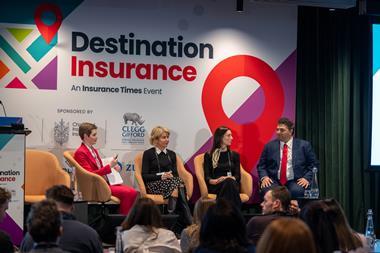
That was according to Caroline Wagstaff, chief executive at the London Market Group, who made the claim during the opening panel session at Insurance Times’ Destination Insurance event, entitled Leadership in 2026.
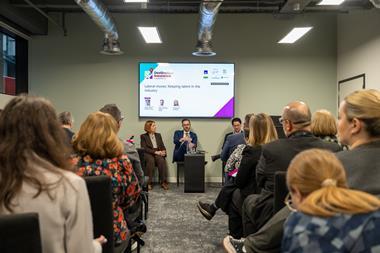
Destination Insurance, which went ahead yesterday (15 January 2026), had a variety of sessions for delegates to take part in, including discussions about insurance’s social value to Gen Z, keeping talent in the industry, creating a shared talent attraction strategy and more.
During the opening session, Wagstaff commented on London market hiring data, which showed that while it employs around 65,000 people, it hires roughly 1,200 young people each year.
”So that’s a very small percentage,” Wagstaff said, adding that 50% of those hires were made by the top five broking firms, with a further 20% taken on by five underwriting businesses.
“What we are seeing is not enough people hiring.
“It’s not that there’s a problem with the number of applications. But what we are seeing is that people are not hiring enough young people.”
In turn, Wagstaff felt that ”we’re looking at the world [through] the wrong end of the telescope and actually we have a demand problem, not a supply problem”.
And she warned that under-hiring was already storing up longer-term consequences for the market, including wage inflation and skills shortages.
Wagstaff said firms that paused recruitment to manage costs would “pay for it in wage inflation in six to seven years time, when you’re all chasing a very small number of late 20s, early 30s staff”.
She added: “Please, can you stop the people saying, ‘Oh, they’ve got to have five years’ experience in insurance slash the London market?’ Because clearly they can’t do the job without that. It’s such nonsense.”
‘Pipe blockage’
The session also explored what Wagstaff described as “pipe blockage” across the talent pipeline, with progression slowing as older workers delayed retirement.
Read: In Focus – Why so many say ‘I fell into’ insurance – and why that’s changing
Read: Briefing – Attracting talent in the UK insurance industry – Progress, challenges and opportunities
Explore more talent related content here, or discover more news here
“The majority of them are in the 45 to 60 bracket,” Carolyn Callan, chief executive for retail at Brown and Brown, said.
However, she warned that knowledge risked being lost as those individuals exited the industry over the coming years.
Despite this, Wagstaff highlighted that the lack of visible progression was already affecting younger staff engagement.
“It’s a bit of a pipe blockage problem, because people can’t see where their careers are going,” she said.
Technology was also flagged as a compounding risk. A question raised from the audience warned that increased use of artificial intelligence (AI) and automation in entry-level processing roles could further shrink the talent pipeline if used primarily as a cost-cutting tool.
“We are seeing the number of roles decreasing and I worry that is a trend. It’s a trend from not a very high base,” Wagstaff responded.
Summing up the discussion, Wagstaff warned that hiring trends were becoming “an increasingly burning platform that we need to deal with” if the industry was serious about resilience around talent going into and beyond 2026.
































No comments yet