























New figures from property data intelligence firm Chimnie, published exclusively by Insurance Times, reveal that the overwhelming majority of London properties will be at risk of subsidence-related damage by the year 2080
One day, a small wrinkle forms in your wallpaper. A month later, you notice the bathroom door seems to be getting stuck a little more often than it used to. A year after that, you drop an apple and realise your bedroom floor has acquired a gentle slope.

Eventually, you peel back the wallpaper and your fears are confirmed – there are cracks in the walls. A structural engineer installs crack monitors and tiltmeters and, three months later, gives you the bad news. Your house is suffering from subsidence.
This stark scenario is a reality for thousands of households each year. In the vast majority of cases, however, insurers are able to help mitigate the financial impact of the repairs. Indeed, ABI figures showed that in 2025 insurers paid out some £307m in subsidence-related claims alone.
But with hotter, drier, subsidence-driving summers becoming the norm, those payouts are growing, and new figures from property data intelligence firm Chimnie – published exclusively by Insurance Times – have revealed that without intervention, London, which is primarily built on shrink-swell clay geology, may be at risk of becoming effectively uninsurable.
Subsidence “redlines”
Colin Herrington, head of claims at Brown and Brown, explained that even now, some insurers will avoid taking on risk in subsidence-prone locations.
Read: Vehicle value swings of up to £7,000 could leave policyholders facing insurance gap
Read: TechTalk – Does Anthropic’s Claude Mythos break the cyber insurance underwriting model?
Explore more Data Matters content here, or discover other news analysis stories here
He said: “Subsidence risk based on soil type is generally factored into area rating, with the highest risk areas attracting higher rates and potentially increased excesses. However, some insurers may ’redline’ entire postcode areas where the soil plasticity index is at its highest.
“The market reduces for individual properties that have had previous problems with subsidence and many insurance providers may entirely avoid homes with previous subsidence claims or repairs.”
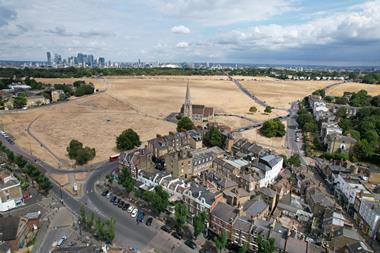
While London’s clay geology is prone to subsidence, rates are currently manageable. East London sees the highest risk levels, with 46% of properties currently at “probable” risk of subsidence, followed by southeast London (41.9%), southwest London (36.9%) and west London (30.5%). None of the other eight major postcodes, however, see rates higher than 2.5%.
But with drought rates forecast by the Intergovernmental Panel on Climate Change (IPCC) set to balloon, so too is the likelihood of clay shrinkage subsidence. By 2050, only the EC and WC postcodes are set to see rates of properties at risk of probable subsidence below 48%. And, by 2080, no London postcode will have rates lower than 94%.
The figures are striking. As Jonathan Francis, founder of Chimnie, explained: “The data shows the risk is largely stable to 2030, then erupts between 2050 and 2080, mirroring IPCC projections for UK drought frequency
“There is a non-linear inflection between 2050 and 2080, which suggests insurers have perhaps a 25-year window before London clay subsidence becomes effectively uninsurable at standard rates.”
Planning for the future
To avoid a scenario whereby large swathes of housing stock become uninsurable, Herrington believes that insurers need to take a pro-active, forward-looking approach, both in their predictive capabilities and their remedial support.
He explained: “The provision of cover for subsidence is critical in supporting the housing market, as cover remains a requirement for most mortgage lenders. Insurers need to be forward-thinking in pricing for the future and work closer with experts from the likes of the British Geological Survey (BGS) in understanding their projections.
“From a claims perspective, non-traditional methods of repair such as resin injection continue to develop and will become more important in an arena of increased frequency.
“It is likely a more pragmatic approach to claims settlements needs to evolve with a view to making the property overall more resilient to future subsidence issues, rather than focusing on localised areas of damage.”
In addition, improved planning and building regulations could be developed with growing subsidence rates in mind, to ensure new build projects do not add to the at-risk housing stock.
So, it appears that while the window to address London’s subsidence risk is shutting, it hasn’t closed entirely. Insurers, regulators, surveyors and homeowners that start adapting now – rather than waiting for the cracks to show – will be best positioned for success into the future.

He graduated in 2017 from the University of Manchester with a degree in Geology. He spent the first part of his career working in consulting and tech, spending time at Citibank as a data analyst, before working as an analytics engineer with clients in the retail, technology, manufacturing and financial services sectors.View full Profile


























No comments yet