


















As the insurance market pushes deeper into AI and automation, Lumara’s chief executive argues that underwriting expertise and broker relationships still matter most
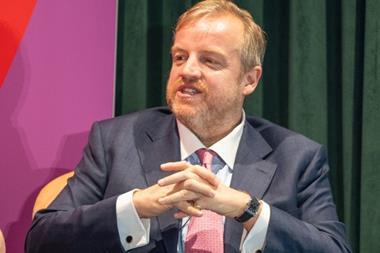
The insurance market may be racing toward automation, artificial intelligence (AI) and digital trading, but for David Aslin, chief executive at Lumara, there is still no substitute for a conversation.

Speaking to Insurance Times at the Biba Conference 2026, Aslin is careful to cut through the noise of industry buzzwords. His MGA, which launched in November 2025, was built around a simple idea – that brokers still want access to experienced underwriters who will pick up the phone.
“Probably about two years ago, this concept was born,” he explains.
“It was based on broker feedback, which told us that one of the big gaps in the market at that time was very much around service and access to people that could make decisions.”
That frustration, he argues, has only intensified as insurers have increasingly leaned into digital trading models and self-service platforms.
“They try to get hold of people. They try to talk about risk, but nobody seems to want to,” Aslin recalls brokers telling him. “People don’t even answer the phones.”
Human-led vision
Lumara’s proposition aims to deliberately push back against the direction broker feedback showed much of the market has taken over the past decade.
Read: Biba 2026: Acorn Group-owned MGA launches first fleet product on Acturis
Read: MGA launches 24/7 virtual underwriting assistant
Explore more MGA-related stories here, or discover more interviews here
Aslin is not anti-technology, far from it. But, after years working in leadership and operational roles at large insurers and MGAs, he believes the industry has over-corrected toward efficiency at the expense of underwriting nuance.
“Technology’s good, but it isn’t necessarily the answer to everything,” he says. “There’ll be business that will be a bit more unique.”
For Aslin, the danger lies in relying too heavily on standardised online trading journeys and drop-down box underwriting. While efficient, he believes these approaches can flatten the individuality of risks.
“Every business you look at there, you’ve got the owner that set up that business,” he says.
“They’ll be looking at it and say, ‘It’s my business, my business might be very similar to another one, but actually, my business might be better than somebody else’s.’”
That is where Lumara wants to differentiate itself, by supplementing technology with experienced and human-led underwriting judgement.
Aslin says: “Usually somebody that’s got 20, 30 years of experience knows how to differentiate.
“They’ve generally learned off other people, so they’ve got much wider understanding of how you look at a risk.”
The MGA describes itself as “human-led” and, listening to Aslin, the phrase feels less like branding and more like a reaction to what he sees as a growing disconnect between brokers and insurers.
“We’re saying, ‘actually, talk to us,’” he says.
Market pressures
Lumara entered the market at a complicated moment.
The business idea was born during harder trading conditions, when insurers were pulling back appetite and brokers were struggling to place certain risks. By the time Lumara launched, however, market conditions had shifted.
“You’ve probably heard people talk about the soft market the last two days,” Aslin says, gesturing toward the bustle of Biba around him.
In a soft market, capacity increases, pricing falls and brokers suddenly have far more choice. For a new MGA trying to establish itself, that creates a different challenge entirely.
Aslin says: “Most of the brokers we talk to will say, ‘I can go and get that from almost anybody at the moment. So why are you different?’”
Lumara’s answer has been to lean harder into relationships and product flexibility.
“We had to think quickly and say, ‘Well, we are different because we’ll still talk to you,’” he said.
The MGA is also selectively choosing who it works with, rather than opening distribution broadly.
“We’re only hand selecting the brokers we want to work with at the moment,” Aslin explains. “Those brokers are typically brokers that are growing. So they need a new business market.”
That targeted approach, he says, is already helping Lumara build traction through new business wins rather than simply fighting over renewals.
Local expertise
Aslin repeatedly returns to the importance of experience throughout the conversation, not only in underwriting decisions, but in maintaining local market understanding.
He reminisces about earlier stages of the insurance market, when regional underwriting offices were deeply embedded within broker communities.
“I spent a lot of time in the regional market at the time when insurers had lots and lots of branch offices,” he says.
“Everything was built around the broker and the underwriters being local.”
That local expertise, he argues, often provided context that technology alone could not.
AI balance
Like most executives at Biba this year, Aslin is watching the rise of AI closely. But his view is notably measured.
“There is a midway point,” he says.
While he sees clear benefits in AI-driven data analysis, particularly around identifying profitable risks and improving efficiency, he is cautious about an industry becoming overly dependent on data-led consensus.
“If everybody has the same data and the same AI modelling, then you’re all going in the same direction,” he says. “So how do you differentiate?”
He also questions what happens to risks that algorithms reject.
“What happens for the business that might be in a flood zone, or might not be wanted by an insurer, because the data and AI says, ‘I would avoid that’?”
For Aslin, the future is not about replacing underwriters, but augmenting them.
“I’d like to think you get to the point where data works really well,” he finishes.
“But ultimately, you’ve still got that human touch around.”

With a background in local journalism, she has previously worked as a freelance reporter covering community stories and gaining valuable on the ground experience.View full Profile























No comments yet