























As the insurance industry moves away from dedicated diversity and inclusion initiatives towards broader conversations about culture, talent and skills, the question is whether this marks genuine progress – or simply makes an old problem less visible
For an industry built around assessing risk, insurance has spent the past decade confronting one within its own walls – whether it is attracting, retaining and progressing people from a broad enough range of different backgrounds.

Diversity, equality and inclusion (DEI) have moved steadily up the industry’s agenda over that period, but the language is changing.
Increasingly, DEI is being folded into broader discussions about culture, belonging, skills and talent. At Axa UK, for example, the language shifted from diversity and inclusion to “inclusion and belonging” three years ago.
Amanda Vaughan, chief people officer at Axa UK and Ireland, said the change has encouraged greater ownership of the issue across the insurer, while the firm has retained “clear goals, metrics and accountability”.
The question facing the insurance sector in 2026 is not whether firms still support DEI – few would argue against the principle – but what happens when it stops being a distinct agenda.
Vaughan pointed to the company’s own data as evidence that this can work. In the past year, 99% of new colleagues submitted diversity data, while 83% of colleagues had answered at least two of its diversity questions. Women now make up 55% of Axa UK and Ireland’s Management Committee.
These numbers do not prove that the industry’s work on DEI is finished, but highlight that the industry is perhaps moving into a new era defined by a holistic approach to progress.
Business as usual
There is a strong argument that DEI becoming part of the industry’s furniture is simply what progress looks like.
Read: Updated insurance apprenticeship standards attract strong market uptake for ‘more modern approach’
Read: Aviva launches broker charity fund-matching scheme
Explore more diversity and inclusion-related content here, or discover other news stories here
Jake Arundell, head of inclusion and diversity for the UK and EMEA at Gallagher, said the industry is increasingly recognising that inclusion should be part of everyday business rather than a collection of standalone initiatives.
“The terminology may evolve over time, but the principles of respect, opportunity and inclusion remain highly relevant,” he said.
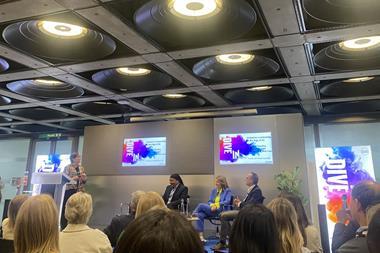
Lloyd’s is making a similar argument, with data to support it. Mark Lomas, head of culture, talent and communities at Lloyd’s, told Insurance Times the market has changed significantly since DEI-focused insurance event Dive In was launched in 2015.
“The importance of culture, diversity and inclusion to business is now well understood,” he said.
Lomas pointed to women now making up 45% of the Lloyd’s market workforce and 37% of leadership, while ethnically diverse groups represent 16% of the workforce and 11% of leaders.
He argued that this progress means the conversation can move towards the next set of challenges facing the industry, particularly the impact of AI and the resulting need for new skills and talent.
“The ability to embed diversity and inclusion in talent approaches based on data, insights and areas of need is something we should celebrate,” he said. “It is because of our success we are able to do that.”
Fiona Temple, people, culture and academy director at the LMA, similarly argued that the industry’s commitment had “evolved and matured, rather than diminished”.
The suggestion from the market is clear – as inclusion has become part of the market’s everyday mechanisms, perhaps the focus on it as a separate part of business operations is no longer necessary.
The visibility problem
But there is a paradox at the heart of this new approach.
If DEI becomes so embedded that it no longer needs to be named, that could indeed be a sign of success. But letting a distinct, visible agenda become business asusual can also make it harder to see who is responsible when progress halts.
Donna Scully, joint owner and director at Carpenters Group, captured this tension: “If everyone owns inclusion, there is a danger that nobody owns it.”
Scully said she believes the industry has made genuine progress, citing women in leadership, employee networks, mental health, neurodiversity, apprenticeships and alternative routes into insurance. However, she believes necessary structural changes remain incomplete.
“Talent is evenly distributed. Opportunity is not,” she said.
The same applies to the language used to discuss the issue. The wider corporate backlash against DEI, particularly in the US, has made organisations more cautious about how they discuss the subject.
Dr Naeema Pasha, a future of work expert, behavioural scientist and visiting fellow at Henley Business School, said: “[This corporate backlash] has tempered the language on DEI.”
But she was wary of treating changing terminology as evidence of either progress or retreat.
“Language is important, but results are more important,” she said.
Hiring the familiar?
There is also a more uncomfortable interpretation of the shift, however.
Raj Tulsiani, founder and chief executive at talent advisory firm Green Park, argued that the industry risks describing retrenchment as evolution.
His concern is that moving towards apparently neutral concepts, such as skills and culture, can allow organisations to become less deliberate about who they hire.
“When you’re afraid, you hire safer. Safer means more familiar. More familiar means less ambition.”
The industry is preparing for AI, cyber risk, climate change and new distribution models, all of which require different skills and perspectives. Yet the instinct to hire familiar candidates sits uneasily with an industry built on identifying overlooked risks.
That is where the industry’s talent argument becomes interesting.
The insurance market needs more people. It needs different skills. It wants younger workers to see insurance as a first-choice career rather than an industry they “fall into”. Diversity is increasingly being presented as part of the solution to that problem.
But there is a danger in making the business case the only case.
Dr Pasha said that there are moral, legal and financial reasons for pursuing equity.
But if diversity is defended only when it can be linked to revenue, productivity or talent shortages, what happens when those financial benefits become harder to demonstrate?
The principle should not depend entirely on its profitability.
The real test
This is where the conversation needs to move beyond language.
Lloyd’s said it now has the infrastructure and measures to track progress. The LMA said the same – representation, progression, employee experience and retention should show whether the agenda is working.
Axa said it continues to maintain clear objectives and rigorous measurement, while using its diversity data to develop initiatives including its black professionals development programme, carers network and ethnicity pay gap reporting.
The questions are straightforward – are people from different backgrounds entering insurance, progressing at similar rates, staying in the industry and reaching leadership positions? And are people from less traditional educational and socioeconomic backgrounds choosing insurance in the first place?
And, perhaps most importantly, do employees actually feel they belong?
If the answers are yes, the fact that the work sits under ‘talent’ or ‘culture’ rather than ’DEI’ becomes much less important.
If the answers are no, a change in terminology starts to look more like a rebrand.
What comes next?
After 12 years, the market is arguing that awareness is no longer the main challenge. Lloyd’s is developing a broader programme around talent and future skills, while the LMA envisages a year-round ecosystem involving mentoring, leadership, networks and early careers.
The real test will be whether that wider approach retains the accountability that made DEI visible in the first place.
There is a case that insurance is entering a more mature phase, one where inclusion is no longer an initiative, but part of what good management means.
There is also a case that making something business as usual can make it easier to stop asking difficult questions about who benefits and who does not.
Both can be true.
As Temple puts it: “Real progress shows up in behaviours, decisions, opportunities and outcomes, not just in the words organisations choose to use.”
Perhaps the future of DEI in insurance should not be judged by how often the industry uses the phrase. It should instead be judged by whether its workplaces, leadership teams and talent pipelines continue to change.
The D-word may become less prominent. The responsibility behind it cannot.

With a background in local journalism, she has previously worked as a freelance reporter covering community stories and gaining valuable on the ground experience.View full Profile
























No comments yet