
























FCA executive director says the regulator expects ‘firms to be more transparent about progression’ because ‘this reflects culture, shapes judgements and outcomes’ linked to Consumer Duty rules
Not-for-profit social mobility membership organisation Progress Together last night (21 May 2026) launched a new campaign – called Making the Invisible Visible – designed to encourage greater socioeconomic diversity in financial services career progression pipelines.
The 12-month campaign was launched by Baroness Mary Goudie at an evening reception held at the Houses of Parliament, with attendees spanning financial services subsectors such as insurance and wealth management.
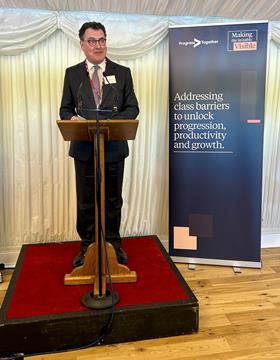
The campaign aims to address “invisible” class barriers affecting career progression, productivity and growth across the UK financial services sector.
Progress Together – which was established in 2022 – plans to achieve this by conducting research and benchmarking work, sharing leadership and employee stories, engaging in policy work and supporting practical employer action.
Speaking at yesterday’s event, Progress Together chairman and former Lord Mayor of the City of London Vincent Keaveny explained that “the financial services sector has a problem around progression”, with “employees coming into the sector from lower socioeconomic backgrounds [progressing] more slowly than their peers from higher socioeconomic backgrounds”.
He added: “The research suggests that can be up to 25% more slowly, with no link to job performance.”
Keaveny emphasised that improving socioeconomic diversity is not just a ‘nice to have’ for organisations, but that it is intrinsic to greater productivity and financial growth too – for both businesses and the UK.
He explained: “Businesses are increasingly facing skill shortages. We have an ageing population and there is a demand for a higher level of skills in our sector. Productivity and economic growth will not improve in this nation without the utilisation to the fullest extent possible [of] the talent that we have.
“Too much talent in this country is being left behind. The left behind communities are a significant drag on our economic growth.
“Social mobility [and] socioeconomic diversity [is] a golden thread that runs through the challenge of diversity and, if you get this right, very often your metrics on other diversity characteristics – on race, ethnicity, gender, sexual orientation – they will be positively impacted as well. So, there’s a real value in getting the socioeconomic diversity challenge right.”
Sophie Hulm, chief executive at Progress Together, added: “Socioeconomic background remains one of the strongest predictors of who gets ahead.
“This is not just a fairness issue – it is a performance issue, it is a productivity issue, it is a competitiveness issue. We are not fully utilising the talent that is in our sector and that is holding us back.”
FCA expectations
Also addressing event attendees yesterday evening was Sheree Howard, authorisations executive director at financial services regulator the FCA.
For her, improving social mobility across financial services is an important way to ensure compliance with the regulator’s Consumer Duty rules, which came into force in July 2023.
Read: Briefing – Why social mobility matters
Read: Brown and Brown partners with social mobility charity to champion early careers
Explore more talent related content here, or discover more news here
She explained: “Financial services may still have unconscious bias, informal sponsorship, assumptions about polish, fit and potential. These don’t appear in any policy documents and they don’t appear in rules – but they do shape careers and they shape firms.
“It isn’t simply about fairness. It speaks to growth, it speaks to competitiveness, it speaks to good risk management and good governance. If firms draw leadership from too narrow a range of experience, they absolutely limit what they notice, they narrow the questions they ask, they narrow the consumers they instinctively understand.
“Under Consumer Duty, understanding consumers from all walks of life is not optional, so all firms must ask themselves if the people shaping [their] decisions do not reflect the communities they serve, how can they be confident that they’re seeing the full picture and meeting the aims of Consumer Duty?
“We at the FCA expect firms to be more transparent about progression, take ownership of your leadership pipelines and look critically at how opportunity is allocated because this reflects culture, shapes judgements and outcomes. This is why the FCA really supports this work.”
Other speakers over the course of the evening included Jane Kielty, outgoing chief executive for UK, Ireland and South Africa at Aon UK, Justin Onuekwusi, chief investment officer at St. James’s Place, and Baroness Mary Goudie.

Since joining Insurance Times, Katie has successfully obtained a number of industry accolades. At trade body Biba's 2025 Journalist and Media Awards, for example, Katie was named the overall winner and received the Journalist of the Year trophy, alongside the Best Thought Leadership Award for her briefing article on reproductive health MGA Juniper and how insurance can be used to positively impact taboo subjects.View full Profile































No comments yet