
























Data from 575 structural feasibility surveys of commercial rooftops has shown that 35% of buildings cannot safely support solar panel installations without remedial work or alterations
As the UK continues its evolution towards sustainable green energy, the number of rooftop-mounted solar panels is on the rise.

Solar panels – as insurers are all too aware – pose a non-negligible fire risk, with QBE research revealing that fire incidents involving photovoltaic (PV) systems grew by almost 60% between 2022 and 2024.
There is, however, another risk associated with solar panels that is getting far less attention – the structural integrity of the rooftops on which they sit.
In the opinion of Sahir Raihan, managing director at Solar Surveys, the management of the panels themselves is the “easy part” – and the question that “too often goes unasked” is whether the building underneath can safely handle the installation of a solar array.
“In about a third of the roofs we assess the honest answer ’is not without some work first’. About one in twenty could not take it safely at all, as proposed,” he explained.
Indeed, data from 575 PV structural feasibility surveys conducted by Solar Surveys between 2024 and 2026 found that over one third of commercial rooftops – such as warehouses, retails units, offices and schools – are not suitable for installation without some form of remedial work.
Structural damage
Of the 35% of rooftops that were found to be unsuitable to immediately support PVs, just 5% were found entirely structurally inadequate. It is, however, the 30% that could support PVs following remedial work that pose the most risk to insurers, given that unsuitable installations could occur if a structural survey was not completed or did not flag the issues.
Read: Claims and customer outcomes reshape insurer placement decisions
Read: TechTalk – Does Anthropic’s Claude Mythos break the cyber insurance underwriting model?
Explore more Data Matters content here, or discover other news analysis stories here
Currently, UK building regulations state that buildings must remain structurally safe after alterations, but do not prescribe how PV installation assessments must be carried out. Many seemingly simple installations can be signed off by installers without a structural assessment, something which Raihan feels leaves properties at risk.
He explained: “For an insurer this is an underwriting and claims question as much as an engineering one. An array bolted or ballasted onto a roof that was never properly assessed is a live structural and water-ingress risk for the whole life of the asset.
“The failure modes are real – uplift or movement of an under-ballasted array in a storm, overload of framing that was never designed for the extra concentrated load, water ingress at poorly detailed fixings and asbestos disturbance, which carries its own liability.”
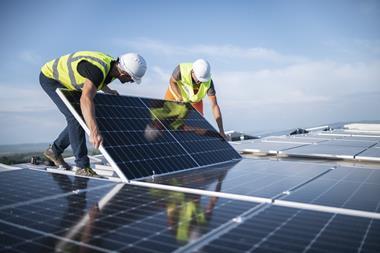
The biggest issues were seen among flat-roofed buildings, for which 78% needed the PV ballast – concrete blocks that hold solar panels down during high winds – to have non-standard configuration. Over-ballasting leaves roofs at risk of overload, while under-ballasting can see panels slide or lift during storms.
For pitched roofs, inadequate support from purlins – horizontal beams that strengthen roof supports – or PV bracket attachments that do not join to sufficiently secure underlying structures proved common issues.
Asbestos cement roofing was also seen in 10% of buildings, which poses a major health risk if disturbed during installation, as well as generally providing a structurally poor surface for support – 62% of asbestos cement roofs failed wind uplift assessments.
“The difficulty is not really technical. Done at feasibility or design stage this is routine engineering and it is cheap. The problem is behavioural – the structural check is the step that gets skipped in the rush to install and it is the one that turns a paper change into a five-figure remediation or a claim,” added Raihan.
“Insurers should know whether a property carries rooftop PV and whether that roof was independently assessed before the panels went on.”
Risk management concerns
Adrian Simmonds, practice leader for property risk solutions at QBE, explained that “solar technology is an essential part of the UK’s clean energy transition, but the rapid pace of deployment is cause for concern for risk management”.
“We strongly encourage property owners to carry out formal risk assessments, engage certified installers and ensure regular inspections and cleaning,” he added.
The insurer also noted that storm wind speeds can occasionally exceed solar panel installation design thresholds and suggested that property owners should therefore apply “one-in-100-year” criteria at the design stage.
Simmonds added that “roofs and panels should be inspected after storms or high winds, as even minor dislodgement or debris can increase fire risk”.

He graduated in 2017 from the University of Manchester with a degree in Geology. He spent the first part of his career working in consulting and tech, spending time at Citibank as a data analyst, before working as an analytics engineer with clients in the retail, technology, manufacturing and financial services sectors.View full Profile





























No comments yet