






















‘If we don’t recognise it’s happening, we don’t get control of it – it’s going to get out of control,’ says insurance risk engineer
The number of fires involving solar panels in the UK has risen by 60% in two years, prompting insurers to warn that commercial installations require proactive risk management.
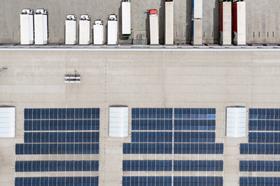
Data from a freedom of information request submitted by QBE to UK fire authorities revealed that fire incidents involving solar photovoltaic (PV) systems increased from 107 in 2022 to 171 in 2024. Commercial properties accounted for 27 of these incidents – representing 18% of the total.
Adrian Simmonds, practice leader for property risk solutions at QBE, said the normalised increase in fire rates remained significant despite the growing number of installations.
He said: “If you do the number of fires per installation in 2022 it’s around about one in 12,000 – if you look at the same for 2024 it’s about one in nine, nearly 10,000.
”That’s actually only a 22 and a half percent normalised increase. However, 22 and a half percent increase is still quite notable. It’s not a small increase.
“I class it as more like an amber flag rather than a red flag, because if we don’t recognise it’s happening, we don’t get control of it – it’s going to get out of control.”
Ageing systems and installation errors
Industry figures identified early-generation installations from the 2010-2015 period as a driver of today’s fire risk.
Read: Clean energy revolution facing extreme weather challenge
Read: Rooftop risks – how is the insurance sector tackling the proliferation of solar panels?
Explore more ESG-related content here, or discover other news analysis stories here
Graham Sellers, forensic electrical engineer at Halliwell Forensics, said many systems installed during the initial solar boom have received no maintenance since.
“A lot of their systems were fitted in 2012, 2013, 2014 – they’ve had absolutely no maintenance among them for 10, 15 years,” he explained.
“The technology was quite immature and they didn’t realise exactly what they were doing. A lot of people were just fitting isolators – AC isolators, not DC isolators – and they were causing problems.”
Simmonds echoed this concern, noting that component lifespans often fall short of system design expectations.
He said: “Poorer standards of installation were the situation 10 to 15 years ago, even five years ago.
“The systems are designed nominally for a 25 year life but, actually, very few of the components actually have a 25 year life. Inverters, we’re finding, are only having a 10 to 15 year life or less.”
Research from 2025, published by the Building Research Establishment, attributed 36% of 58 PV fire events to installation errors and 12% to faulty products, with a Clean Energy Associates study in 2023 finding that 97% of inspected systems across 14 countries exhibited some form of defect.
While commercial installations may account for fewer incidents numerically, insurers warned that they represent a disproportionately higher loss severity.
Dan Wilkins, property technical risk manager at Axa UK Commercial said: “Commercial solar PV systems are typically much larger than home installations, with higher capacities and more extensive infrastructure. Consequently, a fire or damage can result in significantly greater property loss, business interruption and operational disruption.”
Sellers reinforced the scale of potential losses for commercial property owners.
“Obviously, if you lose the roof, the losses are huge, because you’ve got your business interruption losses, which is one of the bigger losses of this,” he said.
Technical causes and manufacturer response
The QBE data identified DC connectors as a primary ignition source, with the industry now actively working to address component failures.
“The faults are mainly sitting in the connectors, the things they call the DC connectors. They are the primary cause of the failures, and the industry is aware of it,” Simmonds said. “So manufacturers, suppliers are changing the way they design those pieces of kit.”
Sellers highlighted how simple maintenance could prevent common ignition mechanisms.
“I’ve come across a lot of fires in the DC isolator, simply because it’s never been turned,” he said.
A further risk identified by Sellers involved the removal and reinstallation of panels during roof repairs on commercial buildings – with contractors often reusing degraded seals.
“They then put the panels back on and remake the connection, but they’re using the same 15 year old rubber O seals,” he warned.
“They’re not going to work after 15 years. You shouldn’t reuse old seals, but they are because they’re just remaking the connections.”
Regulatory outlook and industry action
Experts were unanimous that the perception of solar panels as a “fit and forget” technology was fundamentally flawed.
“Just be aware that solar isn’t fit and forget. It’s fit and maintained,” Sellers warned.
Wilkins recommended routine inspections and maintenance at least annually to identify early signs of faults or damage, with larger or critical systems potentially requiring more frequent checks.
“We are seeing many older installations without proper inspection or maintenance routines, as many older systems were sold as ‘fit and forget’. Such neglect can significantly elevate fire and failure risks,” he said.
Axa said it was monitoring ongoing loss history to determine whether mandating inspections by way of policy endorsement would be necessary.
Simmonds predicted stronger regulation would emerge within the next four to five years, driven by the industry itself.
“It’s the industry themselves who are pushing for it, because ultimately they don’t want to be selling a product that people are saying, they burn, they catch, they kill people,” he said.
Wilkins emphasised that the two most important considerations remained choosing a reputable MCS-registered installer and ensuring ongoing maintenance.
“The insurance industry can help ensure that solar PV systems remain an amber flag by promoting and supporting the adoption of best practices in installation, maintenance and system design,” he said. “By providing clear guidelines, encouraging regular inspections and adherence to recognised safety standards, insurers can reduce the likelihood of preventable faults that lead to fires, thereby managing risk proactively.”
Simmonds concluded with a call for vigilance.
“Let’s get control of it by the various means, both in terms of regulation and quality of equipment and quality of installation,” he said. “I think it shouldn’t become a red flag, which, to me, means it’s out of control.”





























No comments yet