



























Panellists suggested that industry practitioners reinvesting acquisition proceeds could provide fresh backing for independent brokers, while consolidators’ portfolio reviews may release businesses for new owners
Wealth generated by broker buyouts could help finance a new wave of independent businesses, as industry practitioners return to the market as investors rather than founders.
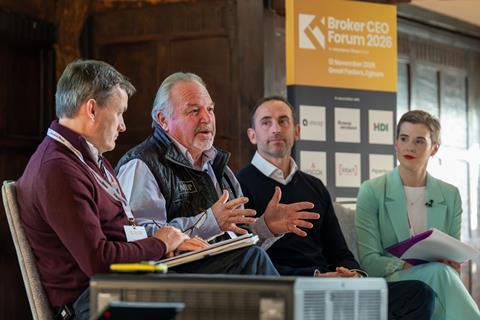
That was according to panellists speaking at the recent Insurance Times Broker CEO Forum 2026, who discussed M&A trends in a session entitled ’Broker scale, deconsolidation and the next phase of market evolution’.
Alastair Lester, chief executive of private equity (PE) and M&A for EMEA at Gallagher, identified an emerging pool of investors who had made money through the sector and were now looking to put that wealth back to work.
He said: “There’s this whole pool of people who’ve made money through the industry – not PE people – who are now becoming quasi-family offices themselves,” he said.
And for brokers seeking backing, these investors with direct experience of building and selling insurance businesses could bring an understanding of where a new business might find room to compete.
Lester said these practitioners knew the industry “inside out” and understood where to find differentiation. Crucially, their investment horizons could also differ from those associated with private equity ownership.
“Some of those people will have five to 10 year horizons, not three to five year horizons,” he said.
His comments raised the prospect that the proceeds of the previous wave of consolidation could help finance fresh competition, giving entrepreneurs another potential route to backing beyond an institutional investor.
Assets coming loose
That potential fresh supply of capital looking to invest in insurance could coincide with opportunities to acquire businesses or operations that no longer fit within larger groups.
Read: Briefing – Roman generals, rusty swords and the likely broker re-independence agenda
Read: On the mid‑tier squeeze – too big to exit, too small to absorb the shock
Explore more broker-related content here, or discover other news stories here
Derek Coles, chief executive at Uris Group, suggested that, after bringing numerous assets together, consolidators were increasingly examining whether everything they owned remained relevant to their strategies.
Some acquisition activity had amounted to “a scrabble for ebitda”, he said, with a subsequent review of costs and customer relationships prompting some owners to distinguish between operations worth retaining and those better suited to another home.
“This part of that asset is still good for our go-forward strategy, this part no longer really fits,” he said, describing the decisions businesses could face.
Coles expected assets to “come loose from consolidation”, creating opportunities for other businesses.
The implication was not that consolidation would reverse, but that portfolio rationalisation and reshaping could create openings for buyers with a different strategy, including those looking to develop an existing operation instead of starting from scratch.
For Coles, acquiring and improving an overlooked business offered an alternative to the difficult work of establishing a “greenfield operation”.
He described his preference as being “to buy something else that somebody’s disregarded, polish it, turn it around and push it on”.
His comments pointed to two potential ingredients for the next phase of independent growth – experienced investors willing to supply capital and existing operations that could develop under different ownership.
Neither was presented as a guarantee of a new wave of deals, however. Lester described an emerging investment trend, while Coles’ expectations concerned assets that could become available, rather than a confirmed pipeline of disposals.
More than a funding decision
For Broadway Insurance Partners founder and chief executive Daniel Lloyd-John, the choice of funding that broker leaders had to make was also becoming less automatic.
Discussing the options available to his business, he pointed to insurer capital, debt financing and money deployed by private entrepreneurs, alongside conversations with private equity and venture capital investors.
He explained: “It isn’t just let’s build Broadway and then an inevitable venture capitcal (VC) or PE conversation.”
However, he did not dismiss institutional investment. Lloyd-John said he had been impressed by investors’ willingness to get to know Broadway and its approach before a potential transaction.
The broader question was how ownership could support the proposition a business wanted to build, rather than treating a particular source of capital as the inevitable destination.
That distinction also ran through Lester’s assessment of private equity. While describing himself as a believer in its contribution to the sector, he highlighted the pressures arising from its investment model.
“[PE investors] are there to invest, deploy funds and generate returns in a defined timeframe,” he said.
Changes in interest rates, pricing conditions and the wider economy could alter the assumptions underpinning an investment, requiring businesses to adapt.
For any newly backed independent, however, access to money would be only part of the challenge. Lloyd-John emphasised talent, cultural environment and client relationships as areas in which businesses could distinguish themselves in a crowded market.
Equally, buying assets would not make scale an end in itself. Whether a business grew through acquisitions or built its own team, the value of expansion ultimately depended on what clients experienced.
As Lester noted: “Scale’s great, but when clients have to navigate the complexity of scale, it falls over.”

With a particular interest in regulation, technology, innovation and political stories, he has covered issues from the multioccupancy buildings scandal to the insurance implications of quantum computing and the growth of new markets.View full Profile






























No comments yet