

























New claims data from Insurance DataLab shows that brokers are increasingly souring on insurers that provide them with poor claims outcomes
Claims have long been viewed as the point at which an insurer’s promise is ultimately tested – but the latest data suggests that the commercial consequences of failing that test may be becoming more severe.

The second wave of Insurance DataLab’s Commercial Lines Claims Pulse, conducted in partnership with Research in Finance, has found that 75% of brokers are satisfied with the overall claims experience, only marginally below the 77% recorded in the inaugural study carried out in spring 2026.
On the surface, that points to a relatively stable market, but dig beneath the headline figure and a more significant shift starts to emerge.
Among brokers who had an unsatisfactory claims experience, 82% said their trust in the insurer fell as a result, up from 78% in the first wave. Even more strikingly, half said they are unlikely to place business with the insurer again in the following 12 months, compared with 39% previously.
At the other end of the spectrum, 92% of brokers who reported a satisfactory claims experience said they were likely to place business with the same insurer again, compared with just 12% of those who were dissatisfied.
For insurers, the message is clear – while overall satisfaction remains relatively resilient, brokers appear to be becoming less tolerant of poor experiences.
Insurance DataLab co-founder Dan King said the results should serve as a warning to insurers about the commercial consequences of poor claims performance.
He explained: “The headline satisfaction score has not moved dramatically, but the reaction to a poor experience has. What really stands out from this wave is that brokers appear to be less forgiving when claims service falls short.
“Half of dissatisfied brokers now say they are unlikely to place with that insurer again, and that turns claims performance into a very direct commercial issue.”
And King added that poor claims experiences can quickly undermine the investment insurers make in building strong broker relationships.
“An insurer can invest heavily in distribution, pricing and broker relationships, but if the claims experience undermines trust when the client needs them most, a lot of that goodwill can disappear very quickly,” he says.
Product line data
The latest results from the Commercial Lines Claims Pulse also underline the extent to which claims satisfaction varies by product line.
Read: In Focus – Is claims experience beginning to overtake price as the deciding factor for customers?
Read: An arms race is brewing in claims handling
Explore more claims-related content here or discover other news analysis articles here
Business equipment and office contents remains one of the strongest-performing areas, with satisfaction increasing from 87% in the first wave to 94% in the latest results.
Directors’ and officers’ insurance also improved, rising from 82% to 84%, while employers’ liability recorded satisfaction of 86% and professional indemnity 83%.
But not every part of the market moved in the same direction.
Satisfaction with commercial combined policies fell from 84% to 79%, while marine, aviation and transport dropped from 81% to 76%.
General liability recorded the largest fall among the product lines highlighted in the first wave, declining 10 percentage points from 83% to 73%.
Commercial motor, meanwhile, remains one of the more challenging lines for claims satisfaction, holding at 70% despite accounting for more claims experiences than any other product line in the survey.
Meanwhile, construction produced one of the weakest results, with just 57% of brokers satisfied with the claims experience.
King explained that these differences reinforce the need to look beyond market-level averages when assessing insurer performance.
“A single market-wide satisfaction figure can only tell you so much,” he said.
“The differences between product lines remain substantial and that matters because the claims journey in commercial motor can look very different to the experience in D&O, liability or specialist property.”
Movement at the top
There has also been significant movement among the market’s leading insurers.
Travelers topped the second-wave rankings, with 89% of brokers satisfied with their overall claims experience, down slightly from 91% in the inaugural study.
Sompo ranks second with satisfaction of 86%, followed by Chubb and Markel at 83%. Hiscox recorded 82%, Zurich 81% and Axa XL 80%.
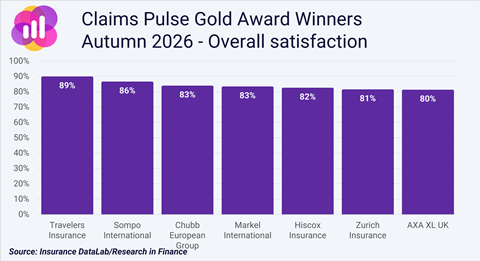
All seven received an Insurance DataLab Commercial Lines Claims Gold Award for their strong performance.
However, the make-up of the Gold Award group changed materially between the two studies.
Travelers, Markel and Hiscox are the only three insurers to retain gold status from the first wave, with Sompo, Chubb, Zurich and Axa XL joining the leading group following the latest results.
Chubb recorded one of the strongest improvements among the second-wave winners, with overall satisfaction increasing from 78% to 83%, while Zurich rose from 79% to 81%.
King said this highlighted one of the advantages of the survey being able to track claims performance over time rather than relying on a one-off snapshot.
“With two waves of data, we are starting to get a much better sense of consistency,” he noted.
“Claims performance is not static. Some insurers are improving, others are slipping back and the composition of the leading group has already changed quite considerably.
“That is important for brokers because historical reputation only goes so far. What really matters is how an insurer is performing now, whether that performance is consistent and whether the claims experience being delivered matches the expectations set at placement.”
Different strengths within the claims journey
Overall satisfaction is only one element of the Claims Pulse research.
The study also breaks the experience down into three broad areas – initial response, claims handling and customer outcomes – giving a more detailed picture of where individual insurers are performing most strongly.
While Travelers leads the market for overall satisfaction, Sompo produced some of the strongest individual scores across the claims journey.
It is the highest-rated Gold Award winner for initial response, with satisfaction of 90%, as well as customer outcomes at 88%. Its claims handling score of 85% is also among the strongest in the market.
Markel, meanwhile, recorded the highest claims handling satisfaction score among the Gold winners at 86%, alongside 88% for initial response and 84% for customer outcomes.
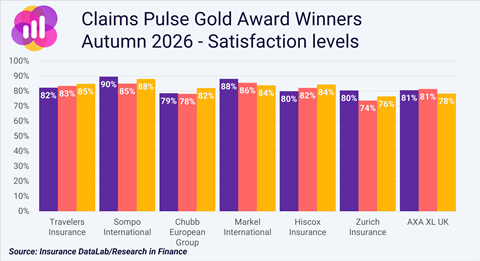
Its improvement from the first wave is particularly notable, with satisfaction around initial response rising by more than 10 percentage points, claims handling increasing by around six percentage points and customer outcomes by more than five percentage points.
Travelers combined an initial-response satisfaction score of 82% with 84% for claims handling and 85% for customer outcomes. While its scores for initial response and handling are slightly lower than in the first study, customer outcomes improved by around six percentage points.
Chubb also made significant progress on customer outcomes, rising from around 74% in the first wave to 82%, helping lift its overall satisfaction score by more than five percentage points to 83%.
Hiscox strengthened across all three parts of the journey despite its overall satisfaction remaining broadly stable, with initial response rising from 72% to 80%, claims handling from 72% to 82% and customer outcomes from 78% to 84%.
Zurich and Axa XL also improved across all three areas compared with the first wave as both moved into the Gold Award group.
That more granular view is critical.
King explained: “Overall satisfaction is important, but it is the journey underneath that score that often tells you more. You can see insurers with very similar headline results but quite different strengths and weaknesses when you look at response times, communication, accessibility, claims handling and the eventual customer outcome – something that partner insurers can see in even more granular detail on our insight platform.
“The strongest performers tend to be those that are able to deliver a high degree of consistency throughout the process, rather than excelling at one stage and then falling away at another.”
Claims as a placement factor
That consistency is likely to become increasingly important as brokers face greater pressure to evidence insurer selection and demonstrate that placement decisions are delivering good customer outcomes.
Claims performance has always influenced broker relationships, but the Claims Pulse findings indicate it can also have a measurable impact on where future business is placed.
The first wave of the research established a strong link between satisfaction, trust and placement intention. The second wave not only reinforces that relationship, but suggests that the downside of a poor experience may be increasing.
With 82% of dissatisfied brokers reporting a reduction in trust and 50% unlikely to place with the insurer again, claims performance now carries consequences that can extend well beyond an individual loss.
King added: “For brokers and their clients, claims are where the insurance proposition becomes real – if an insurer handles that well, it can strengthen the relationship. If it does not, the effect can carry straight through into future placement decisions.
“That is why claims performance should increasingly be viewed as part of an insurer’s wider competitive proposition. The firms that can demonstrate consistently strong outcomes are giving brokers another reason to place business with them.”
And after two waves of the Claims Pulse, that relationship is becoming increasingly visible.
Overall satisfaction may have changed only modestly, but beneath the headline number the market remains highly varied – between insurers, product lines and across different stages of the claims journey.
And with brokers becoming less willing to overlook a poor experience, delivering consistently when a claim occurs is an increasingly important point of differentiation for insurers.

































No comments yet