
























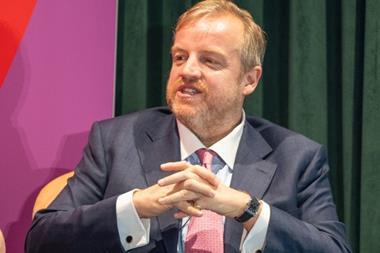
Jonathan Zhao, global insurance leader and Hong Kong financial services managing partner at EY Advisory, tells Insurance Times why Asia Pacific is leaving Europe behind on insurance innovation, why boardrooms are immobilised by AI and why UK insurers must stop looking inward.
Jonathan Zhao, global insurance leader and Hong Kong financial services managing partner at EY advisory, does not soften his message for a British audience.

He states that, in comparison to Asian markets, “the whole of Europe, including the UK, is slightly lagging behind in technology innovation”.
It is a blunt assessment, but one Zhao evidences by way of a decade old example that still has no mainstream equivalent in the UK market.
He points to Chinese insurer Ping An, which, more than 10 years ago, committed to paying motor claims in full within two hours of an accident – with the ability to process this through a photograph of the damage.
That timeline matters. Ping An’s Smart Claims platform now uses artificial intelligence image recognition to assess vehicle damage and determine liability within an average of 7.4 minutes, with 93% of auto insurance claims processed through AI-assisted systems.
Meanwhile, according to insurance provider MarshMallow, the average UK motor claim can take ”anything from a few days to a few months” to settle, depending on complexity.
For Zhao, the contrast is structural, not superficial. He believes UK insurers have spent too long polishing the shop window while neglecting the machinery behind it.
“Many of the insurers in Europe, including the UK, probably focus a lot on the front office, where they have to sell stuff, rather than thinking about how to make things more efficient,” he says.
Blank paper versus legacy burden
The explanation, Zhao argues, is partly historical. China’s modern commercial insurance market began in the 1980s following economic reform – making it little more than 45 years old in its current form.
Read: Lloyd’s issues comment after it reportedly ‘quietly shelves Blueprint Two’
Read: What lies ahead for UK insurance in 2026?
Explore more insurer related content here, or discover more news here
The UK market, by contrast, carries centuries of accumulated infrastructure and institutional complexity. Lloyd’s of London’s historic processes and legacy systems have made digital transformation more complex than in newer insurance markets, as evidenced by the insurance market’s flagship project Blueprint Two floundering.
“The China insurance business is only 30 plus years old, whereas the UK market is 100-plus years old, so you have a lot of legacy,” Zhao says.
“If you start with a blank piece of paper, it’ll be much easier than trying to fix everything.”
The point is clear – and uncomfortable. European insurers are not incapable of innovation. They are simply weighed down by the very history that once made them world leaders.
“When they start realising they’re lagging behind, sometimes it’s a bit too late and then you just have to copy,” Zhao adds.
Scale economics compound the problem. China has 1.4 billion people, according to World Bank data. The UK has approximately 69 million. The Organisation for Economic Co-operation and Development (OECD) describe the UK as one of the highest for penetration rates for insurance.
“In China we have 1.4 billion people,” Zhao says. “In the UK market, there’s so many competitors in the small market.”
The accountability question
If legacy drag explains the technology gap between European and Asian markets, Zhao argues that a different kind of immobilisation is stalling progress on AI – one rooted in generational tension.
He observes that while most insurance boards recognise AI as transformative, few feel equipped to act.
Zhao captures the mood with characteristic directness.
He says: “Sometimes I still feel like they’re not that comfortable because they don’t know what they don’t know.”
What troubles boards most, he suggests, is not the technology itself – but the question of who carries the blame when it fails.
“What if something goes wrong? Who will be responsible?” he asks. “You cannot say, ’AI is the one that did this thing.’”
The European Commission’s AI Act, meanwhile, will impose strict compliance requirements on high-risk AI systems, including human oversight and accountability. But Zhao sees these frameworks as incomplete.
“None of the [European] regulators have very clear regulations around how and what they allow AI to do and not allow it to do,” he says.
A message for UK chief executives
Despite his comments on the European market as a whole, Zhao reserves his sharpest commentary for the direction of the UK market. He notes that many of the country’s largest players have withdrawn from international markets over recent years to refocus on domestic operations. For example, firms such as Aviva and Intact Insurance Group. For example, in 2021, Aviva agreed to sell its Vietnam business to Manulife.
“A lot of the large UK player used to be very international, but they’re all retracting back into the UK. I think it’s a pity,” he says.
His advice to any UK insurance chief executive is pointed.
“If you focus only on the UK market, you’re too inward looking,” he says. “I would start looking outside on what other people are doing in all the key markets that I’m not doing.”
Zhao sees a sector at a crossroads. Legacy systems and an ageing leadership cohort risk trapping UK insurers in outdated models while faster, younger markets build the future.
“The traditional way, five years from now, will become obsolete,” he warns.
He pauses, then offers the line that perhaps best captures the scale of the challenge ahead.
“You’re putting a technology that changes daily into a 100-year-old industry.”




























No comments yet