





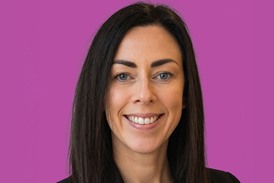
















After 33 years in the industry, Axa’s first group chief underwriting and pricing officer tells Insurance Times why excluding emerging risks like AI goes against insurance’s core purpose
In June 2023, when Axa chief executive Thomas Buberl announced that the global insurer would create its first ever group chief underwriting officer function, he was unequivocal about its importance.

“The creation of a chief underwriting officer function for the group will be key for the implementation of our growth and technical excellence ambition for the next strategic plan,” Buberl said at the time.
The person he chose to build that function from scratch was Nancy Bewlay – a 33-year industry veteran whose career has zigzagged between running businesses and building foundations, from the Lloyd’s market to Bermuda, from Swiss Re to XL Catlin and now to the apex of one of the world’s largest insurers.
“The focus of the role was to build out the first Axa CUO office,” Bewlay explains. “It’s a group role looking over all of our Axa entities, responsible for setting the group standards for technical underwriting.”
It is, by any measure, a significant mandate. Axa operates across tens of countries, writing everything from personal lines motor to reinsurance treaties.
Broker, boardroom and a world without borders
Bewlay’s insurance journey in the early 90’s saw her become a casualty broker at Marsh and McLennan in New York.
Read: Mapped out – How data is helping insurers navigate risky postcodes
Read: Insurers ‘too quick’ to exclude emerging risks
Explore more risk management-related stories here, or discover more news here
Her trajectory accelerated at Swiss Re, where she served as managing director and head of underwriting for casualty across the US and Canada. Then came XL Catlin in 2017 as global chief underwriting officer for casualty – just eight months before Axa acquired the business.
“I helped organise what XL would look like before we became Axa XL,” she recalls.
What followed was an ascent – global chief underwriting officer for long tail lines, then global chief underwriting office lead and ultimately chief executive of XL Reinsurance, before stepping into her current group role in September 2023.
“I’ve been in the industry the whole time, either running the business or creating the technical foundation,” Bewlay says. “I flip back and forth between those two, and that’s very much part of Axa’s DNA.”
That dual perspective – operator and technician – has shaped her leadership philosophy.
“I’ve always been thankful that I have a strong technical foundation to build a strategic plan, whether I’m a chief executive or in the role I’m in today,” she notes.
“You’re best positioned when you understand the business at a granular level.”
If there is one theme that runs through Bewlay’s worldview, it is interconnectedness. Her career has taken her from the North American market to a global perspective.
“When you start in North America, you think ’we’re the biggest market in the world, why does anybody need London? Why does business flow to Lloyd’s?’ she asks.
“And then you work globally and realise just how interconnected everything is.”
That interconnection has only intensified. The Red Sea shipping crisis, which saw insurance costs for transiting the waterway more than double following Houthi attacks, is just one example of how geopolitical shocks now transmit instantly across global supply chains and insurance portfolios.
“If I go back to the beginning of my career, something could happen in one country and not materialise somewhere else,” Bewlay observes. “Today, trends move faster.”
The case against exclusion
Perhaps nowhere is Bewlay’s philosophy more evident than in her approach to emerging risks – particularly artificial intelligence.
While some major insurers have reportedly asked US state regulators for permission to exclude AI-related liabilities from corporate policies – and industry voices increasingly question whether AI is even insurable – Bewlay takes a markedly different view.
”Artificial intelligence is getting a lot of attention,” she acknowledges. “For me, it brings risk in many ways and yes, there is systemic risk.”
But her response to that risk is not retreat.
“What gives me pause is when the industry’s first response is to exclude the exposure,” she says.
Bewlay argues that the instinct to exclude represents a failure of imagination – and of purpose.
“The insurance industry is here for emerging risks,” she insists. “We’re here to study the world’s biggest risks, put structure around them and protect society. My first response is not to exclude AI, it’s to build the infrastructure around the exposure so we can manage it technically and still be there for our clients.”
Axa’s own positioning supports this philosophy. Axa XL has launched cyber insurance products extending coverage to help businesses manage emerging generative AI risks – affirmative cover in a market where many competitors are pulling back.
Other insurers are taking a similar approach. Chaucer, for example, has launched affirmative AI coverage, suggesting that at least some in the market see opportunity where others see only peril.
Bewlay extends this thinking to the broader question of insurability.
“I don’t start from a position that something is impossible to insure,” she says. “I start from the position that the question is ’what can be insurable?’”
“If you have a disciplined portfolio and diversification, you can take measured risk over time. When I hear ‘uninsurable’, I often think the homework hasn’t been done.”
It is an implicit rebuke to an industry that has sometimes been quick to withdraw from complex risks. Pool Re’s success in making terrorism cover accessible and affordable since 1993 – after insurers withdrew from the market following IRA attacks – stands as evidence that solutions can emerge for even the most challenging exposures.
Building for the next leader
With 41% women in Axa’s global leadership network, the insurer has made tangible progress on diversity. But Bewlay frames the issue in starkly practical terms rather than purely moral ones.
“Your clients want to see themselves reflected in you,” Bewlay continues. “Having a globally diverse leadership team opens better debate. You cannot be a global organisation without global and cultural representation.”
Research from Axa Investment Managers supports this view, suggesting leadership diversity may act as a competitive advantage – associated with higher profitability.
For someone who has navigated restructures and turnarounds throughout her career – “some of my toughest roles were coming in at restructure phases, where something was failing and needed to be fixed” – building from a position of strength feels different.
Her advice to early career professionals carries echoes of her own journey: “Learn your trade. Even if you’re in distribution, you need to know what you’re selling. In insurance, you’re selling a promise. You need to understand what that means to the individual.
“Don’t just learn your role – learn how your role connects to everyone else around you. Don’t get pigeonholed.”
As for her own legacy, Bewlay is characteristically clear-eyed.
“What excites me is building something that I can hand over, knowing it’s strong enough for the next person to take further,” she says.
“If I stay too long, I risk becoming stale. I believe in making space for the next leader.”
After 33 years of flipping between running businesses and building technical foundations, Nancy Bewlay is doing both – constructing the underwriting architecture for one of the world’s largest insurers while keeping one eye on who will inherit it.
The homework, it seems, is very much being done.































No comments yet