




















With aviation policy wordings ‘written decades ago’ and deemed ‘pretty much insignificant now’ against current sector aircraft and risks, underwriter recommends collaborative committee as a beneficial model to bring the class up to date
Aviation insurers agree that policy wordings for this specialty line need thoroughly reviewing to eliminate ambiguity in the face of evolving and emerging risks, with Harriet Stewart – senior underwriter at Convex Insurance – proposing that market underwriters create an aligned committee to “develop a wording that doesn’t have gaps, [is] clear [and] doesn’t have ambiguity”.

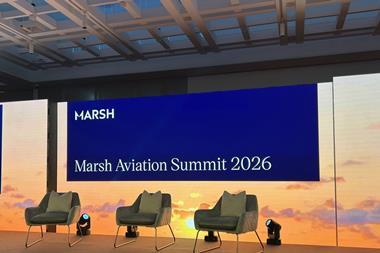
Stewart was speaking at the Marsh Aviation Summit on 15 April 2026 at Vauxhall’s Park Hyatt London hotel, participating in a panel discussion entitled ‘Insurer panel: Aviation risk, capacity and market outlook’.
Within the session, Stewart emphasised that many aviation insurance policy wordings “were written decades ago” – yet, across the board, she believes terms and conditions have not been updated to reflect the “different landscape” evident today.
She explained: “We operate in a different landscape today than we did back then. [The] Boeing 777X [aircraft is] worth circa $450m (£338m). You’ve got engines [worth] up to $60m (£45m). [Yet] you’ve got the same deductible at $1m (£0.75m). It hasn’t moved on.
“The war landscape looks very different now [with] digital warfare and we haven’t really adapted that. Do we need to look at that? Yes. Is it an easy task? No. We’re in a marketplace with multiple stakeholders, so it’s not a quick thing to do.”
Jonathan Milford-Cottam, head of aviation for London at Allianz Global Corporate and Specialty, agreed with Stewart. He added: “We’re starting to get into a hardening market the moment, but during the soft market phase, we [did] see coverage creep [around] engine definitions [and] diversion expenses.
“We’ve got whole deductibles, which haven’t changed for many years and are pretty much insignificant now when you compare them to the actual value of an engine.”
For Matt Church, head of aviation at Sompo, current aviation policy wordings do not adequately reflect the new risks entering the aviation sector, such as the very commercial model being employed around manned space flights. He added that an iterative process to update policy wordings was a must for this class because its past experiences can no longer be used to predict the future of sector risks.
“We want to always drive out any ambiguity from the wordings,” he continued. “Clarity is always better. That’s something we can’t be complacent on [and] forever want to drive forward.”
Tom Breakey, deputy head of aviation for UK and Europe and global head of airlines at Starr, added that insurers should review the intent of their aviation policies, as well as the specific wordings included.
He explained: “For us as insurers, it isn’t necessarily [about] taking away cover [through reviewing policy wordings], but perhaps to stimulate embedding a new product. Leased engine, for example.
“[The] issue for us as insurers [is] there’s been a number of high profile losses. Is there a product that we could implement as a community, a separate product for [specific] engines to give [them] the accountability that [they] deserve?”
Committee creation
The underwriter panellists agreed that a number of risks were well established on their “risk radar”, including “increased costs of aircraft and engine repairs, social inflation, settlement awards, nuclear verdicts, supply chain disruption, cyber security, geophysical events [and] weather events” – all contributing to the need to review and revamp aviation policy wordings.
Read: The Big Question – What is the potential impact of the Middle East conflict on UKGI?
Read: From Dubai with love – a room with a frontline view on a rapidly changing world
Explore more risk management content here, or discover more news analysis here
Stewart believes a productive way to analyse policy wordings is via a sector committee. While acknowledging that insurers certainly “can’t collude” when it comes to pricing, she told delegates that “there are circumstances when it’s beneficial to come together and develop a wording that doesn’t have gaps, that’s clear, doesn’t have ambiguity”.
For her, an ideal way to action this would be using a similar model to the Lloyd’s Market Association (LMA) Marine Committee, which collaborates with industry bodies such as the International Union of Marine Insurance (Iumi) to draft and update standard policy wordings and clauses for the marine insurance industry. She thinks this format could be mirrored for the aviation sector.
“You have to be careful, but it’s something maybe we should be considering as a market because it is in the benefit of our clients to come together and collaborate in that way to come up with a better solution.”

Since joining Insurance Times, Katie has successfully obtained a number of industry accolades. At trade body Biba's 2025 Journalist and Media Awards, for example, Katie was named the overall winner and received the Journalist of the Year trophy, alongside the Best Thought Leadership Award for her briefing article on reproductive health MGA Juniper and how insurance can be used to positively impact taboo subjects.View full Profile



























No comments yet