

























House prices are determined more by the ground they sit on than the bricks and mortar they’re built with and – with buildings insurance cover limits often tied to property valuations – a striking underinsurance divide has developed across the country
Homeowners that have based their buildings insurance coverage on their property’s sale valuation may be surprised to find that, in the event of total disaster, the rebuild cost of their home might differ substantially from what they are insured for.

Furthermore, the extent – and even category – of their coverage issues may depend heavily on their postcode, with a strong north-south divide apparent between the sales value of a house and fraction of that price it costs to rebuild.
The statistics behind these insights comes from property data intelligence firm Chimnie Property Data, provided exclusively for analysis to Insurance Times as part of a new quarterly data partnership.
Jonathan Francis, founder of Chimnie, explained the data behind the partnership: “Our data covers property characteristics, construction attributes, environmental risk, reinstatement cost and valuation-related signals across residential and commercial property in Great Britain and Northern Ireland, helping insurers build a deeper understanding of risk at property level.”
Such insights, he added, can help the industry to “understand broader patterns across the UK – from concentrations of flood exposure to the distribution of older construction types across regions”.
And indeed, the data reveals a stark reality – with house prices across the country largely driven by land value, not the cost of bricks and mortar, homeowners that are basing their insurance coverage on their property value are likely to have incorrect levels of cover.
Rebuild costs
Ian Holloway, head of surveys at Criterion Adjusters, explained: “Rebuild costs tend to be more similar across the country than house prices. The house prices between Wales and London vary massively, but at the level of a standard family home, the rebuild sum is far narrower than what you might expect.”
For high net worth (HNW) houses – in which Criterion Adjusters specialises – this means homeowners are often paying premiums based on property values that are, in reality, far higher than the realistic rebuild costs.
Chimnie’s data revealed that, typically, house rebuild costs sit in the £200,000 to £300,000 range, irrespective of where they are located.
“What we tend to see is affluent people that will purchase a property and insure it for that market value. You’re then in a situation where you’re saying to them that this is not realistic, you’re paying too much for your premium,” Holloway added.
Holloway also highlighted a prominent misconception that properties should be insured for 75% of their market value, an approach that he describes as “an absolute myth”.
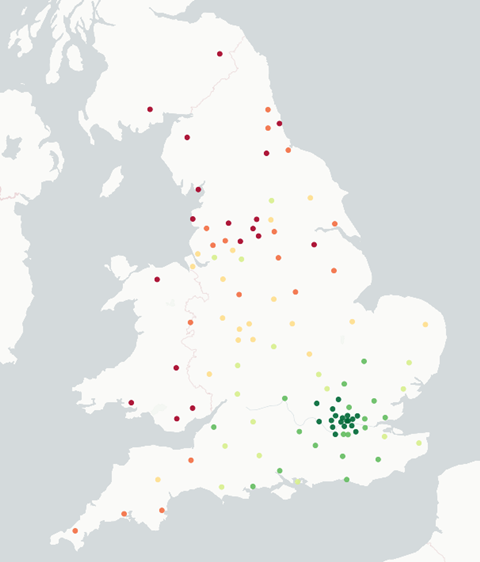
This trend is particularly common in London. Average house prices in south west London currently stand at £794,000. In the event of total destruction, they would cost on average £254,000 to rebuild, just 32% of their market value.
David Fowkes, head of household underwriting at Admiral, told Insurance Times that assessing rebuild costs is “complex”.
He continued: “To manage this, we use multiple rebuild cost models based on typical property characteristics to inform underwriting decisions and, where relevant, to guide customer inputs.
“These take regional rebuild cost variances into account. When asked to provide a rebuild cost, homeowners should only use the models as a guide.”
Underinsured properties
Full rebuilds are rare, and affluent homeowners who are overinsured are likely to see the costs covered in, or near, full. There is, however, a second, sharper edge to the sword – underinsurance.
Read: Standout schemes deliver strong six-monthly earnings, but new business sees mixed momentum
Read: Latest FCA complaints data reveals drop in motor related disputes
Explore more Data Matters content here, or discover other news analysis stories here
Homeowners, particularly those in Wales and the north and west of England, who are insuring their properties based on market value are likely to find that their rebuild costs actually exceed the sales value of their property.
Several regions see rebuild costs outweigh house values by hundreds of thousands of pounds. The most extreme case of this is seen in Swansea, where an average house would cost £147,000 to buy, yet £303,000 to rebuild in full – meaning rebuild costs are equivalent to 207% of house values.
Blackburn, the Scottish borders, Cumbria and north Wales see similar issues, with houses costing almost double to rebuild as to purchase.
Fowkes explained that, in addition, “rebuild costs can exceed modelled expectations where properties have non-standard construction methods or high specification features that materially increase reinstatement costs beyond typical averages”.
To counter this, he added, Admiral has “included unlimited buildings cover as standard across our products, ensuring customers remain protected even where rebuild costs increase over time”.
The issue of underinsurance goes beyond total rebuilds. Many buildings insurance policies contain a “condition of average” or “proportional remedy” clause.
In essence, this means that any payout will be reduced by the proportion by which the property is underinsured. For example, a house worth £300,000 but insured for £200,000 might make a claim for £60,000 of damage. In such a case, the insurer would pay out just £40,000 – equivalent to removing the one third by which the house was underinsured.
With the risks readily apparent, how then can consumers protect themselves from issues with over and underinsurance? According to Helena Evans, managing director at Criterion Adjusters, education is the key.
She concluded: “One thing is the education for the public – there’s the BCIS (building cost information service) guide and the awareness of the difference between purchase cost and rebuild cost.
“The other thing, and we see it more in the HNW world, is when people have a good broker involved. A good broker can advise about cover and prompt their customer at renewal to check everything is all the same.
“You’ll get the general public renewing a policy, but not considering that they’ve bought new things, or extended the house. Awareness of the public is a massive thing.”

He graduated in 2017 from the University of Manchester with a degree in Geology. He spent the first part of his career working in consulting and tech, spending time at Citibank as a data analyst, before working as an analytics engineer with clients in the retail, technology, manufacturing and financial services sectors.View full Profile































No comments yet